Monday, February 21, 2011

February 27, 2011 – 8th Sunday in Ordinary Time (Sexagesimus Sunday)

Today is Sexagesimus Sunday.  Ash Wednesday is but a week and a half away.
“Remember man that thou art dust and unto dust thou shalt return.”
Readings

Isaiah 49:14–15
I will never forget you.

Psalm 62:2–3, 6–9
R. Rest in God alone, my soul.

1 Corinthians 4:1–5
. . . . he will bring to light what is hidden in darkness
and will manifest the motives of our hearts . . . .

Matthew 6:24 –34
. . . .  seek first the kingdom of God and his righteousness . . . .
Listen Here!    

Do Not Be Anxious (a reflection by Scott Hahn; edited, added to, bolded and graphically enhanced by Soutenus)

We are by nature prone to be anxious and troubled about many things.

In Sunday’s Gospel, Jesus confronts us with our most common fears. We are anxious mostly about how we will meet our material needs—for food and drink; for clothing; for security for tomorrow.
Yet in seeking security and comfort, we may unwittingly be handing ourselves over to servitude to “mammon,” Jesus warns. “Mammon” is an Aramaic word that refers to money or possessions.
Jesus is not condemning wealth. Nor is he saying that we shouldn’t work to earn our daily bread or to make provisions for our future.

It is a question of priorities and goals. What are we living for? Where is God in our lives?
Jesus insists that we need only to have faith in God and to trust in his Providence.

The readings this Sunday pose a challenge to us. Do we really believe that God cares for us, that he alone can provide for all our needs?
That well-known Scripture from Matthew 6 will be read this Sunday:

Look at the birds in the sky;
they do not sow or reap, they gather nothing into barns,
yet your heavenly Father feeds them.
Are not you more important than they?
Can any of you by worrying add a single moment to your life-span?

Think about it - really ponder the beauty of those words. And what about these words from Scripture?

Learn from the way the wild flowers grow.
They do not work or spin.
But I tell you that not even Solomon in all his splendor
was clothed like one of them.

If God so clothes the grass of the field,
which grows today and is thrown into the oven tomorrow,
will he not much more provide for you, O you of little faith?

Do we believe that he loves us more than a mother loves the infant at her breast, as God himself promises in this week’s beautiful First Reading? Do we really trust that he is our rock and salvation, as we sing in the Psalm?

Jesus calls us to an intense realism about our lives. For all our worrying, none of us change the span of our days. None of us has anything that we have not received as a gift from God (see 1 Cor. 4:7).
St. Paul reminds us in the Epistle that when the Lord comes he will disclose the purposes of every heart.
We cannot serve both God and mammon. We must choose one or the other. Our faith cannot be partial. We must put our confidence in him and not be shaken by anxiety.

Let us resolve today to seek his Kingdom and his holiness before all else—confident that we are beloved sons and daughters, and that our Father in heaven will never forsake us.


Scott Hahn, Ph.D


John Michael Talbot wrote a beautiful song based on Psalm 62


Sometimes songs can help us remember Scripture!


Go right to 2:26 for the beginning of the song OR right to 3:48 for Scripture reference. One of my very favorite scenes from the movie version of Godspell . . .


Bishop Anthony B Taylor 's Homily:

Probably most of us have had at one time or another some troubling experience that forced us to open our eyes to some reality to which we previously had been blind. What went on inside you the first time you ever saw desperate poverty? I remember how I felt the first time I ever saw a filthy baby held by a toothless young mother with sunken cheeks begging for a few coins and realized that worse than her material poverty was the profound sense of abandonment — the spiritual poverty—the loneliness, fear and despair lurking behind her sad eyes.

Poverty and despair are as old as the human race but once our eyes are opened to these and other human tragedies, we have a choice. We can give away a few coins and then close our eyes to the bigger issues lurking below the surface, try to put it all out of our mind, or we can keep our eyes open and gain a new, more accurate, understanding of reality that puts everything else in a different light. That’s what Jesus is trying to accomplish in today’s Gospel.

We, like the people in Jesus’ audience, spent most of our time working to earn money to buy things. And Jesus warns us of a danger lurking below the surface of this necessary human activity: “You cannot give yourselves to God and money. I warn you, then: do not worry about your livelihood, what you are to eat or drink or use for clothing…look at the birds in the sky. They do not sow or reap…yet your heavenly Father feeds them. Are you not more important than they?” Jesus invites us to open our eyes to see that in our blindness we often give more importance to things, than to our relationship with God. And here he is talking about food, drink and clothing! Can you imagine what he would say to those who put luxuries before their relationship with God! This is a very easy trap to fall into. The danger is that this can come to become our whole world and we begin to view all of reality as just so many goods. And sad to say, our American society has bought into this consumer mentality.” For instance:

Whenever the main reason we come to Church is to get something out of it, we’ve made religion into a commodity. We all want Mass to be a good experience, but whenever we actually feel shortchanged because the homily is mediocre or the priest has an accent or the music is disappointing, we need to ask ourselves why we came here in the first place. The main reason for coming to Church is to give rather than to get: to give ourselves to the Lord and to give him thanks for his many blessings, which is what the word Eucharist means: Thanksgiving.

Children become a commodity whenever we calculate how may we can afford to acquire and then use artificial means to prevent against excess “inventory” rather than first asking God in prayer to guide our decisions, and then using Natural Family Planning in order to work with the Lord in being wise stewards of the Gift of Life, all the while remaining open to whatever God’s will is for us. But that’s not how it is for most Americans. In American law today, the parents are consumers and the child in the womb is a commodity. The parents decide whether to keep the product or send it back (abortion), especially if quality control (amniocentesis) says there are defects. Some will sue for damages if the doctor doesn’t give them a perfect baby.

Adults in the work force become commodities: valuable so long as we are productive members of society. Our salaries tell us how much we are worth. Did you ever wonder why so many retirees die within a year of retirement? They no longer feel worth anything.

Jesus challenges this consumer mentality. He calls it idolatry. He calls it slavery. He says: “You cannot be the slave of both God and money.” None of us can be the slave of two masters: we will either hate the first and love the second, or treat the first with respect and the second with scorn. Each of us chooses the master of our life. Will we live according to the consumer mentality which promises happiness that it cannot deliver and values us only for what we produce? Or will we live according to the Christian mentality, the way of truth and life, which values us for who we really are—children of God, brothers and sisters of Jesus and each other, temples of the Holy Spirit… having God-given intrinsic worth (even those people viewed by others as a burden on society!) from the first moment of conception and all 9 months in the womb, through those unproductive years of childhood and those supposedly unproductive years of old age, all the way to natural death!

Our Lady of Hope parish in Hope, AR on Saturday, February 26, 2011 and at St. Barbara Parish in DeQueen, AR and St. Edward Parish in Texarkana, AR on Sunday, February 27, 2011. 
ADDENDUM:
A truly wonderful homily by Msgr. Charles Pope can be found HERE.
Msgr. Charles Pope is with the Archdiocese of Washington. The originating URL for his Homily is HERE.

Tuesday, February 15, 2011

February 20, 2011 – Seventh Sunday in Ordinary Time

Readings:

Leviticus 19:1–2, 17–18
The Lord speaks through Moses - note the same message in the Gospel!

Psalm 103:1–4, 8, 10, 12–13
R. The Lord is kind and merciful.
 
1 Corinthians 3:16–23
We are temples of the Holy Spirit at baptism.


Matthew 5:38–48
The Lord speaks through his son and our savior, Jesus Christ - note the repetition of the message in the first reading!  Theses are the last ten verses of the the Sermon on the Mount.
“ . . . . . that you may be children of your heavenly Father, for he makes his sun rise on the bad and the good, and causes rain to fall on the just and the unjust . . . . ” (Mt 5:45)

Scott Hahn's Reflection of the Readings followed by an amazing article, Militant Faith, by John Kavanaugh (edited by Soutenus) . . . . .
We are called to the holiness of God. That is the extraordinary claim made in both the First Reading and Gospel this Sunday.

Yet how is possible that we can be perfect as our Father in heaven is perfect?

Jesus explains that we must be imitators of God as his beloved children (Eph. 5:1–2).

As God does, we must love without limit—with a love that does not distinguish between friend and foe, overcoming evil with good (see Rom. 12:21).

Jesus himself, in his Passion and death, gave us the perfect example of the love that we are called to.
He offered no resistance to the evil—even though he could have commanded twelve legions of angels to fight alongside him. He offered his face to be struck and spit upon. He allowed his garments to be stripped from him. He marched as his enemies compelled him to the Place of the Skull. On the cross he prayed for those who persecuted him (see Matt. 26:53–54, 67; 27:28, 32; Luke 23:34).

In all this he showed himself to be the perfect Son of God. By his grace, and through our imitation of him, he promises that we too can become children of our heavenly Father.

God does not deal with us as we deserve, as we sing in this week’s Psalm. He loves us with a Father’s love. He saves us from ruin. He forgives our transgressions.

He loved us even when we had made ourselves his enemies through our sinfulness. While we were yet sinners, Christ died for us (see Rom. 5:8).

We have been bought with the price of the blood of God’s only Son (see 1 Cor. 6:20). We belong to Christ now, as St. Paul says in this week’s Epistle. By our baptism, we have been made temples of his Holy Spirit.

And we have been saved to share in his holiness and perfection. So let us glorify him by our lives lived in his service, loving as he loves.
__________________________________________________________________

Militant Faith . . . . “Love your enemies.”

The Sermon on the Mount (can be) so baffling, we sometimes ignore it or pretend we never heard it. Those tactics failing, we turn it inside out. The first time I came across such a strategy was after a lecture I gave on “Capital Punishment and Disarmament in the Light of the Gospels.” My assigned task was apparently not very successfully accomplished. From the back of the room came a courageous dissenting voice. “How can you be against war and capital punishment? Even Christ said, ‘an eye for an eye, a tooth for a tooth.’”

What can one do? Why even say that the very next sentence of Jesus in Matthew continues: “But what I say to you is: offer no resistance to injury. When a person strikes you on the right cheek, turn and offer him the other”?

We’ve had these words since the beginning of our church, and by and large we still act as if Jesus said, “an eye for an eye.” Even if we finally acknowledge that Jesus did solemnly tell us to turn the other cheek, in our more candid moments we admit that we think it’s outrageous.

Sometimes I feel everything in my being recoils from the words of Jesus. I want even more than an eye for an eye. And who has a right to ask me for an extra shirt, much less a coat? I reluctantly give up a minute of service, much less a mile. Go two miles? Love enemies? It’s hard enough to love those close at hand.
 

When I see my own resistance to the gospels, how can I be upset if my country thinks it is sheer idiocy? Try forgiving the creep down the street, much less Saddam Hussein.

Our resistance to the gospel is all of a piece. To hold myself not accountable is to hold my family, community or nation not accountable. To exempt any of these groups from the truth is to exempt myself.

In The Old Testament without Illusion biblical scholar John L. McKenzie notes that Christians have felt compelled to create and honor a political ethic where Christ is useless. But such a maneuver invites tragedy, because the political is always in some way personal, and the personal, political. When we make decisions as a nation or a church as if the Incarnation has not happened and Jesus has not died, personal imitation sooner or later follows suit.

The way of Jesus stands in contrast to our personal wars as well as our public ones. As McKenzie puts it, “You cannot be a Christian in private and a secularist every place where your life impinges upon the public; or, to steal another phrase, you cannot serve God and Mammon.” McKenzie goes on to say that Christians who think they can serve both God and Mammon support just wars. The same can be said for capital punishment.

It is not easy. The demons of the world and of our hearts seduce us into thinking that the ways of God cannot be followed in this time-bound journey. Even the commands that the Lord gave to Moses seemed so impractical. “Speak to the whole Israelite community and tell them: Be holy, for I, the Lord your God, am holy.” They were to have no hatred for brother or sister, to take no revenge, to cherish no grudge against fellow citizens, to love their neighbors as themselves. So the Israelites, like all nations, all peoples, weighed the shrewdness of the world, of self-defense, of retaliation, on a balance with the wisdom of God.

For myself, what got me to speak less confidently about capital punishment and forgiveness of enemies was the terrible murder of a young girl, the daughter of a friend of mine. He was a fellow professor at the university and a deacon in a local parish. I found myself avoiding him, especially after the murderers were caught and put on trial. I knew full well that he was aware of my facile arguments against capital punishment, and I was almost ashamed to have him look at me.

Finally one day we were suddenly on the same elevator; I could not escape. I murmured how difficult it must be to go through the trial, reliving his great loss once again. “Yes,” he said, “but the hardest thing is trying to convince the prosecutors that we want life imprisonment without parole and not the death penalty. He doesn’t understand that we follow Christ in all of this.”

Here was someone, profoundly injured by an unjust aggressor, who really believed and wanted to practice the words of Jesus. He really believed in a God who gives sun and rain to the unjust as well as the just. He really aspired to a love made perfect in the Crucified who asked forgiveness for enemies. He had entered the mystery of which Paul spoke. He knew that all things were his, and he was Christ’s, and Christ was God’s

“Are you not aware that you are the temple of God and that the Spirit of God dwells in you: lf anyone destroys God’s temple, God will destroy him. For the temple of God is holy, and you are that temple.” So also, somehow, is the criminal and the enemy, despite the empty wisdom of the worldly wise.
John Kavanaugh, S. J. of Saint Louis University
A thought for today:
Perhaps there is a “pagan” side of each of us which demands revenge, severity and quid-pro-quo exchanges. The only way to banish the pagan is through God's love and grace. We are called to this kind of holiness.
We are only constructing false security when we plan revenge and war. Our real security lies in Christ - period.


SOURCES:
Scott Hahn
John Kavanaugh 
Larry Gillick, S.J., of  Creighton University 
Cartoon - Cartoon Stock


Wednesday, February 9, 2011

February 13, 2011 – 6th Sunday in Ordinary Time

Affair of the Heart

Sir 15:15-20  
(God never asks more of us than we are capable)

Psalm 119:1–2, 4–5, 17–18, 33–34   
(R.Blessed are they who follow the law of the Lord!)

1 Corinthians 2:6–10   
(What eye has not seen, and ear has not heard . . . . )


Matthew 5:17–37  
(Revealing the deeper meaning and purpose of the Ten Commandments and the moral Law of the Old Testament)

MEMORY VERSE!  Matthew 5:19  
 Therefore, whoever breaks one of the least of these commandments and teaches others to do so will be called least in the kingdom of heaven. But whoever obeys and teaches these commandments will be called greatest in the kingdom of heaven.

Jesus tells us in the Gospel this week that he has come not to abolish but to “fulfill” the Law of Moses and the teachings of the prophets.

 Whenever I hear this, my mind plays a quick re-run of Godspell. I can hear:  "the law and the prophets, the law and the prophets, the law and the prophets!" As off track as that musical was at times - especially depending on the director and ensemble - it helped me in my faith journey as a kid. (Yes, I am THAT old!)

In the Gospel reading Jesus reveals the deeper meaning and purpose of the Ten Commandments and the moral Law of the Old Testament. But his Gospel also transcends the Law. Remember He came not to abolish but to “fulfill”.

He demands a morality far greater than that accomplished by the most pious of Jews, the scribes and Pharisees.

Outward observance of the Law is not enough. It is not enough that we do not murder, commit adultery, divorce, or lie.

The law of the new covenant is a law that God writes on the heart (see Jer. 31:31–34). The heart is the seat of our motivations, the place from which our words and actions proceed (see Matt. 6:21; 15:18–20).

Jesus, this week, calls us to train our hearts, to master our passions and emotions. And Jesus demands the full obedience of our hearts (see Rom. 6:17). He calls us to love God with all our hearts, and to do his will from the heart (see Matt. 22:37; Eph. 6:6)

God never asks more of us than we are capable. That is the message of this week’s First Reading.
~~~> The key to this, I believe, is that we can't and shouldn't attempt to handle anything alone. We need our God. It is prideful to shut Him out. Pull yourself up by your bootstraps? That is an incomplete secular command. We are capable WITH GOD's graces.
It is up to us to choose life over death, to choose the waters of eternal life over the fires of ungodliness and sin.
~~~~> We can only do this with God. Each and every decision we make takes us closer or farther from God. Each and every one.

By his life, death, and resurrection, Jesus has shown us that it is possible to keep his commandments. In baptism, he has given us his Spirit that his Law might be fulfilled in us (Rom. 8:4).
The wisdom of the Gospel surpasses all the wisdom of this age that is passing away, St. Paul tells us in the Epistle. The revelation of this wisdom fulfills God’s plan from before all ages.
Let us trust in this wisdom, and live by his Kingdom law.

As we do in this week’s Psalm, let us pray that we grow in being better able to live his Gospel, and to seek the Father with all our heart.


SOURCES: 
Bible
Scott Hahn, Ph.D.
Edited by me/Soutenus (all of my additions to Scott Hahn's commentary are in blue)  
Bolding is also my emphasis. Paragraph formatting and graphics -- also my addition.
I am so grateful to Scott Hahn for these Bible reflections based on the Sunday Readings. Our family uses them to help us prepare for Mass -- that preparation always includes some editing/re-arranging/bolding/notation/graphics to help us get the most out of his commentary. We post here for family and friend sharing & input.

Thursday, February 3, 2011

February 6, 2011 – 5th Sunday in Ordinary Time

This is a post in progress - it will be completed by Saturday (yep, running a bit late this week) :-)
Listen Here!      Light Breaking Forth
Readings:
Isaiah 58:7-10
Psalm 112:4-9
1 Corinthians 2:1-5
Matthew 5:13-16


Jesus came among us as light to scatter the darkness of a fallen world.
As his disciples, we too are called to be “the light of the world,” he tells us in the Gospel this Sunday (see John 1:4–4, 9; 8:12; 9:5).

All three images that Jesus uses to describe the Church are associated with the identity and vocation of Israel.
Salt of the Earth
City Set on a Mountain
Light of the World

SALT 
God forever aligned his Kingdom with the Kingdom of David and his sons by a “covenant of salt,” salt being a sign of permanence and purity (see 2 Chron. 13:5, 8; Lev. 2:13; Ezek. 43:24).

CITY on a hill   
Jerusalem was to be a city set on a hill, high above all others, drawing all nations towards the glorious light streaming from her Temple (see Isa. 2:2; 60:1–3).

LIGHT 
And Israel was given the mission of being a light to the nations, that God’s salvation would reach to the ends of the earth (see Isa. 42:6; 49:6).

The liturgy shows us this week that the Church, and every Christian, is called to fulfill Israel’s mission.
By our faith and good works we are to make the light of God’s life break forth in the darkness, as we sing in this week’s Psalm.

This week’s readings remind us that our faith can never be a private affair, something we can hide as if under a basket.

We are to pour ourselves out for the afflicted, as Isaiah tells us in the First Reading. Our light must shine as a ray of God’s mercy for all who are poor, hungry, naked, and enslaved.

There must be a transparent quality to our lives. Our friends and family, our neighbors and fellow citizens, should see reflected in us the light of Christ and through us be attracted to the saving truths of the Gospel. 

So let us pray that we, like St. Paul in the Epistle, might proclaim with our whole lives,
“Christ and him crucified.”


Yours in Christ,


Scott Hahn, Ph.D.

Go right to the 6 minutes and 57 second mark (6:57) for "You are the Light of the World."  I so wish there was a saved video of the 70s Broadway version of this song! This movie version is not quite even  adequate . . . .  I have saved it here to remind myself of the Broadway version.
http://www.youtube.com/watch?v=Pln3l9d8cJ8&feature=BF&list=PL611E69A3C52C59E4&index=8

Sunday, January 23, 2011

January 30, 2011 - 4th Sunday in Ordinary Time - Cycle A

The Beatitudes - Historical Cultural Context
1st Reading: Zephaniah 2:3; 3:12-13
Responsorial Psalm: 146:6-7, 8-9, 9-10
2nd Reading: 1 Corinthians 1:26-31

Gospel: Matthew 5:1-12a  

HONOR IN THE BEATITUDES 
The most basic piece of information that a modern Western believer should learn about the Mediterranean world of Jesus is that honor, its central value, drives all behavior. Honor is a public claim to worth and a public acknowledgment by others of that claim.

BEATITUDES
The more than eighty “beatitudes” sprinkled throughout the Old and New Testaments are poetic sayings that present, encourage, and praise honorable behavior. Rather than “happy,” “fortunate,” or “blessed,” the first word in each beatitude should more correctly be translated “truly honorable” or “highly esteemed” (is the one who behaves or thinks thus and so).

BEATITUDES IN JESUS’ SERMON
Luke
(6:17-49) presents what were very likely the “original” three beatitudes Jesus spoke on that occasion; Matthew creatively expands them to eight. 
Matthew uses the appropriate grammatical form: third person singular (“honorable the one who ...”). 
Luke gives them a more personally direct orientation by using the second person singular (“honorable are you who . . .”). 
Matthew’s sermon will occupy our attention from now to the ninth Sunday in this cycle.

The three basic honorable and esteemed behaviors offered by Jesus are 

1) being poor
2) mourning
3) hungering. 
“Poor” in the Bible is never an economic designation. It rather describes someone who has temporarily lost honorable status and must seek at all costs to regain but never surpass that status.

“Poor” thus refers to a revolving class of people. The customary association of poor with widows and orphans confirms this notion of losing status. Widows and orphans did not have to retain this position forever. Widows could remarry (see the serious discussion of “real” widows in 1 Tim 5:3-16); orphans could be reabsorbed into an extended family. Those who lost status were culturally obliged to regain it.

There are, however, two distinctive elements in Jesus’ beatitudes. 

1) First, he says being poor constitutes true honor! 
2) Second, the passive voice in each beatitude (“will be comforted,” “be filled,” etc.) is a strategy used by our ancestors in the faith to avoid saying the name of God. Those who engage in social protest (mourning and fasting) will be comforted by whom? By God, of course! This grammatical usage in the Hebrew and Greek Bible is called, appropriately, the “theological or divine passive voice.”

In Jesus’ view, true honor and esteem are determined and bestowed by God, very publicly, for all to see. And the things that God considers truly honorable and worthy of praise are almost always the opposite of what human beings of any culture think.

Though modern American believers are not driven by the values of honor and shame as is the Mediterranean world, crises often indirectly reveal our genuine assessment of values. The survivors of a hurricane will say again and again that life is more precious than possessions. Yet given new opportunities, many would return to collecting material possessions and resuming conspicuous consumption. These are, after all, signs of American “honor.” 

Our culture, which is tragically devoid of God, esteems a way of life that is in direct contradiction to God's ways. . . . all the more reason to be in the world but not if it.  1st John 2:15 - "Do not love the world or the things of the world. 7 If anyone loves the world, the love of the Father is not in him."
That only becomes more important as time goes by. 
 This article has been edited by Soutenus
Original Author: John J. Pilch of Georgetown University

This Scott Hahn's reflection on the readings. "The Blessed Path"
Listen Here!

In the readings since Christmas, Jesus has been revealed as the new royal son of David and Son of God. He is sent to lead a new exodus that brings Israel out of captivity to the nations and brings all the nations to God.
As Moses led Israel from Egypt through the sea to give them God’s law on Mount Sinai, Jesus too has passed through the waters in baptism. Now, in today’s Gospel, He goes to the mountain to proclaim a new law - the law of His Kingdom.

The Beatitudes mark the fulfillment of God’s covenant promise to Abraham - that through his descendants all the nations of the world would receive God’s blessings (see Genesis 12:3; 22:18).

Jesus is the son of Abraham (see Matthew 1:1). And through the wisdom He speaks today, He bestows the Father’s blessings upon “the poor in spirit.”

God has chosen to bless the weak and lowly, those foolish and despised in the eyes of the world, Paul says in today’s Epistle. The poor in spirit are those who know that nothing they do can merit God’s mercy and grace. These are the humble remnant in today’s First Reading - taught to seek refuge in the name of the Lord.

The Beatitudes reveal the divine path and purpose for our lives. All our striving should be for these virtues - to be poor in spirit; meek and clean of heart; merciful and makers of peace; seekers of the righteousness that comes from living by the law of Kingdom.

The path the Lord sets before us today is one of trials and persecution. But He promises comfort in our mourning and a great reward.

The Kingdom we have inherited is no earthly territory, but the promised land of heaven. It is Zion where the Lord reigns forever. And, as we sing in today’s Psalm, its blessings are for those whose hope is in the Lord.


Yours in Christ,


Scott Hahn, Ph.D.
~~~~~~~~~~~~~~~~~~~~~~~~~~~~~~~~~~~~~~~~~~~~~~~~~~~~~~
To Be Blessed: An Attitude
                      A wonderful article by Pat Gohn
Edited by Soutenus

The Beatitudes are meant to shape and form us—like "be attitudes."
They teach us the way that Jesus wants us to be.
The Beatitudes give us choices to deliberately "be more" than minimalists or skimmers of the surface of life.
They dare us to believe in the necessity of being a blessing now in exchange for a blessing yet unseen.
This is no immediate transaction. The return on one's investment is in the hands of God.

When we listen to this Gospel at Mass this weekend, we will be challenged to be like Jesus. To be like Jesus is to reflect his countenance, and to be his charity in the world.

Just think about the face of Jesus and picture his example in each of the Beatitudes. Jesus is a living portrait of how "to be " human. He models the attitudes and dispositions that make up a life of love and service.

Finally, the words of the Beatitudes are more than just a listing of good advice or proverbial wisdom. They point out the path to happiness both in this life and the next.

God's creation of us destined us for beatitude.
We were made for more: We were made for happiness. In fact the Catechism of the Catholic Church says our vocation is beatitude—happiness, supreme blessedness.
The Beatitudes respond to the natural desire for happiness. This desire is of divine origin: God has placed it in the human heart in order to draw man to the One who alone can fulfill it. (Catechism of the Catholic Church, par. 1718)
The Beatitudes respond to the desire for happiness that God has placed within our hearts. In a surprising paradox, we find that the things we fear might make us unhappy really do just the opposite!

St. Thomas Aquinas taught that "God alone satisfies." That's why Heaven is the goal of life. The Beatitudes point to the beatitude of Heaven. But until we can achieve such a magnificent destiny, following God's way now will bring us a glimpse of heaven's happiness on earth.
It is the unfolding of blessedness in our midst.

Pat Gohn is a writer, speaker, and host of the Among Women podcast and blog. She holds a Masters in Theology, and a Bachelors in Communications. Her passion is working within the sphere adult faith formation both in parish life and in using media for evangelization and catechesis. Find more at PatGohn.com.


Monday, January 17, 2011

January 23, 2011 - 3rd Sunday in Ordinary Time


Listen Here!     History Redeemed 
(a reflection on the readings by Scott Hahn)
Readings:
Isaiah 8:23-9:3
Psalm 27:1,4,13-14
1 Corinthians 1:10-13,17
Matthew 4:12-23


Today’s Liturgy gives us a lesson in ancient Israelite geography and history.
Isaiah’s prophecy in today’s First Reading is quoted by Matthew in today’s Gospel. Both intend to recall the apparent fall of the everlasting kingdom promised to David (see 2 Samuel 7:12-13; Psalm 89; Psalm 132:11-12).

Eight centuries before Christ, that part of the kingdom where the tribes of Zebulun and Naphtali lived was attacked by the Assyrians and the tribes were hauled off into captivity (see 2 Kings 15:29; 1 Chronicles 5:26).

It marked the beginning of the kingdom’s end. It finally crumbled in the sixth century B.C., when Jerusalem was seized by Babylon and the remaining tribes were driven into exile (see 2 Kings 24:14).
Isaiah prophesied that Zebulun and Naphtali, the lands first to be degraded, would be the first to see the light of God’s salvation. Jesus today fulfills that prophecy - announcing the restoration of David’s kingdom at precisely the spot where the kingdom began to fall.

His gospel of the Kingdom includes not only the twelve tribes of Israel but all the nations - symbolized by the “Galilee of the Nations.” Calling His first disciples, two fishermen on the Sea of Galilee, He appoints them to be “fishers of men” - gathering people from the ends of the earth.

They are to preach the gospel, Paul says in today’s Epistle, to unite all peoples in the same mind and in the same purpose - in a worldwide kingdom of God.

By their preaching, Isaiah’s promise has been delivered. A world in darkness has seen the light. The yoke of slavery and sin, borne by humanity since time began, has been smashed.

And we are able now, as we sing in today’s Psalm, to dwell in the house of the Lord, to worship Him in the land of the living.


Yours in Christ,


Scott Hahn, Ph.D.
_______________________________________________________________________________
For the younger ones . . . . from Sadler Religion.  Reflection followed by discussion . . . .

Reflection on 1st Reading  Isaiah 8:23-9:3

Most of us know how it feels to live in the "land of gloom" for a few hours or days or even longer. The people in the region around Galilee were overcome by gloom when their enemy, the Assyrians, conquered them. But Isaiah promises that God's power is greater than the powers of darkness. "A great light" will lead them into "abundant joy."

Jesus is "the great light" who leads us out of the land of gloom. By his death and resurrection, he has assured us that darkness can never have the last say.

Discussion Questions for 1st Reading

Sometimes we get used to living in gloom. What would it feel like to have our gloom lightened and brightened? Sometimes we get used to living with a burdensome yoke. What would it feel like to have that yoke smashed? We can get used to living under the rod of a "taskmaster" (that is sometimes ourselves). What would it feel like to have that rod and those tasks lifted from us? Identify the gloom and the yoke and the burdensome (unimportant) tasks. Ask the Lord to come, shine his light, and set you free for the important things in life. What do you want more of in your life?

Reflection on 2nd Reading  1 Corinthians 1:10-13, 17

People who live in the light must avoid divisions and rivalries. Even though the followers of Christ are uniquely different from one another, Paul reminds us that Christ cannot be divided. And we cannot change his message to suit ourselves. Christ's cross is at the heart of our Christian faith.

It is perfectly natural to have favorites in our lives. We have favorite people, favorite teachers, favorite friends. However, we must always remember that even our favorites are human beings like us. No one is perfect except Christ, and it is him that we are to follow. Our favorite people can be role models for us, but we cannot put them in the place of Christ and his loving action in our lives.

Discussion Questions for 2nd Reading

How do we feel when someone we have looked up to fails in some way? Does this mean we were wrong to look up to them? Does this mean that they were all wrong in everything they said or did?

Someone once asked a very old religious sister, "Who is Jesus to you?" She very quickly answered, "The Lord is my ROCK." When someone fails us, do we talk to Christ about it, or do we stay in our disappointment and anger? How can we help ourselves and others to accept disappointments as part of life? How can disappointments in life lead us to lean on Jesus more as our steadfast rock?


Reflection on the Gospel Reading Matthew 4:12-17

Once again the gospel focuses on Jesus as the Promised One of the Old Testament. Jesus began his preaching in Galilee and is identified by Matthew as "the great light" foretold by Isaiah. Jesus' first message to God's people is a powerful one. He says that we should reform our lives, or repent, for "the kingdom of heaven is at hand."

Discussion Questions for the Gospel Reading

"To repent" means that we take a complete change of direction in our lives. Jesus made it possible for all of us to begin again and be saved.
After John was put in jail, he knew that preparing God's people for the kingdom was now totally up to him. So he chose a place to live (Capernaum-by-the-sea) and "began to proclaim." Jesus made a new beginning.

Chaim Potok, a Jewish novelist, once began one of his novels with the statement, "Beginnings are hard." To repent means to begin again. When have you made a new beginning? How can you make a new beginning today in some area of your life?

Saturday, January 8, 2011

Sunday, January 16, 2011 (Second Sunday in Ordinary Time - Cycle A)

Reading I: Isaiah 49:3, 5-6
Responsorial Psalm: 40:2, 4, 7-8, 8-9, 10
Reading II: 1 Corinthians 1:1-3
Gospel: John 1:29-34

 
From an early Church Father, Cyril of Alexandria:
When he saw Jesus coming toward him John said: “Behold the Lamb of God, who takes away the sin of the world.”

No longer does he say: Prepare. That would be out of place now that at last he who was prepared for is seen, is before our very eyes. The nature of the case now calls for a different type of homily. An explanation is needed of who is present, and why he has come down to us from heaven.

So John says: Behold the Lamb of God, of whom the prophet Isaiah told us in the words: He was led like a sheep to the slaughter, and like a lamb before his shearer he opened not his mouth.
You can read the rest of  Cyril of Alexandria's  homily here. 
 ~~~~~~~~~~~~~~~~~~~~~~~~~~~~~~~~~~~~~~~~~~~~~~~~~~~~~~~~~~~~~~~~~~~~~~~~~~ 

Focusing on the Gospel:  
Key words and phrases: John . . . saw Jesus, baptizing with water, one who sent me, see the Spirit come down and remain, Behold the Lamb of God

To the point:  John was actively watching for the Messiah. Faithful to his mission to baptize all those who came to him, John readily recognized Jesus as the Messiah when the Spirit came down and rested upon him.
What about us: We too recognize Jesus when we actively watch for his coming into our lives and must remain faithful to the mission God has given us.
Our mission: There is a clear mission we all have - Matthew 22: 36-40 
To love and serve the Lord your God with all your heart, with all your soul, and with all your mind.
And to  love your neighbor as yourself.
The whole law and the prophets depend on these two commandments.
 How we live out that mission brings us closer or farther from God. We need to always remember to ask God to show us the vocation He has chosen for us.  I believe that should be a foundational prayer. 
"God please make known to me my vocation. Grant me the wisdom to know what you want me to do. Please help me trust in You. Please give me the courage and passion to live the life you want me to live. I believe, Lord! Help my disbelief!  Not my will but yours be done! And, Lord, if it is not too much to ask . . .  please bend me to your will so that I may better serve you. Through Jesus Christ Our Lord. Amen."

Connecting the Gospel: 
to the first reading: Israel, God’s servant, shines with the glory of God and leads all nations to salvation. 
In the gospel Jesus is the glorified One upon whom the Spirit rests and who leads all nations to salvation.
to experience: We see what we look for. If we look for Jesus, we will see him  
~~~~~~~~~~~~~~~~~~~~~~~~~~~~~~~~~~~~~~~~~~~~~~~~~~~~~~~~~~~~~~~~~~~~~~~~~~

Scott Hahn's Reflection on the Readings!

January 16, 2011 - 2nd Sunday in Ordinary Time


Perfect Offering  Listen Here!


Jesus speaks through the prophet Isaiah in today’s First Reading.
He tells us of the mission given to Him by the Father from the womb: “‘You are My servant,’ He said to Me.”

Servant and Son, our Lord was sent to lead a new exodus - to raise up the exiled tribes of Israel, to gather and restore them to God. More than that, He was to be a light to the nations, that God’s salvation may reach to the ends of the earth (see Acts 13:46-47).

Before the first exodus, a lamb was offered in sacrifice and its blood painted on the Israelites’ door posts. The blood of the lamb identified their homes and the Lord “passed over” these in executing judgment on the Egyptians (see Exodus 12:1-23,27).

In the new exodus, Jesus is the “Lamb of God,” as John beholds Him in the Gospel today (see 1 Corinthians 5:7; 1 Peter 1:18-19). Our Lord sings of this in today’s Psalm. He has come, He says, to offer His body to do the will of God (see Hebrews 10:3-13).

The sacrifices, oblations, holocausts, and sin-offerings given after the first exodus had no power to take away sins (see Hebrews 10:4). They were meant not to save but to teach (see Galatians 3:24). In offering these sacrifices, the people were to learn self-sacrifice - that they were made for worship, to offer themselves freely to God and to delight in His will.

Only Jesus could make that perfect offering of himself. And through His sacrifice, He has given us ears open to obedience, made it possible for us to hear the Father’s call to holiness, as Paul says in today’s Epistle.

He has made us children of God, baptized in the blood of the Lamb (see Revelation 7:14). And we are to join our sacrifice to His, to offer our bodies - our lives - as living sacrifices in the spiritual worship of the Mass (see Romans 12:1).


Yours in Christ,


Scott Hahn, Ph.D.
 ~~~~~~~~~~~~~~~~~~~~~~~~~~~~~~~~~~~~~~~~~~~~~~~~~~~~~~~~~~~~~~~~~~~~~~~~~~
St. Vincent Bascilica Parish, Latrobe, PA. artist: Joseph Reiter

SOURCES:  
  1. Cyril of Alexandria *
  2. Thoughts from the Early Church @Center for Sunday Liturgy
  3. Living Liturgy: Spirituality, Celebration, and Catechesis for Sundays and Solemnities Year A - 2011, p. 45.  Joyce Ann Zimmerman, CPPS; Kathleen Harmon, SND de N; and Christopher W. Conlon, SM 
* Cyril of Alexandria (d.444) succeeded his uncle Theophilus as patriarch in 412. Until 428 the pen of this brilliant theologian was employed in exegesis and polemics against the Arians; after that date it was devoted almost entirely to refuting the Nestorian heresy. The teaching of Nestorius was condemned in 431 by the Council of Ephesus at which Cyril presided, and Mary’s title, Mother of God, was solemnly recognized.


The incarnation is central to Cyril’s theology. Only if Christ is consubstantial with the Father and with us can he save us, for the meeting ground between God and ourselves is the flesh of Christ. Through our kinship with Christ, the Word made flesh, we become children of God, and share in the filial relation of the Son with the Father. 


LAGNIAPPE: Paintings of Lamb of God - Agnus Dei

Drawing for the Agnus Dei, Giulio Romano, ink on paper c.1540  
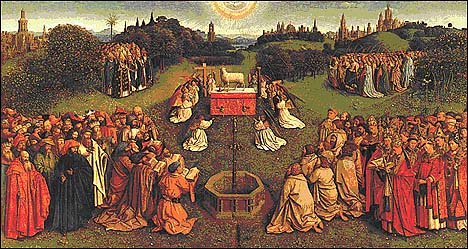
Adoration of the Lamb, by Jan van Eyck (1432), oil on wood, Ghent altarpiece, Cathedral of St. Bavo, Ghent.  
Paul Myhill, Agnus Dei (contemporary painter) 
The Lamb of God in the heaven.ceiling of the vatican embassy in Sofia, Bulgaria 
Izumi Fukushima, Japanese-style painting artist, Romanesque Lamb of God. Contemporary painter. 
Niko Pirosmani, God's Lamb,  Oil on oil-cloth, 55x61 cm. The State Museum of Fine Arts of Georgia, Tbilisi.  
Painting of the Agnus Dei (Lamb of God) above the apse windows by Joseph Reiter. St. Vincent Bascilica Parish, Latrobe, PA. (Virtual Tour of St. Vincent Bascilica in PA)


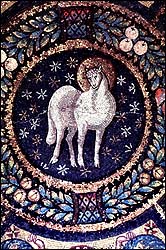
Saint Patrick's Cathedral, Ireland, Saint Peter's Chapel, the Jellett window with Lamb of God, created by C.E. Kemp. San Vitale, Ravenna (begun 532, consecrated 547A.D),    


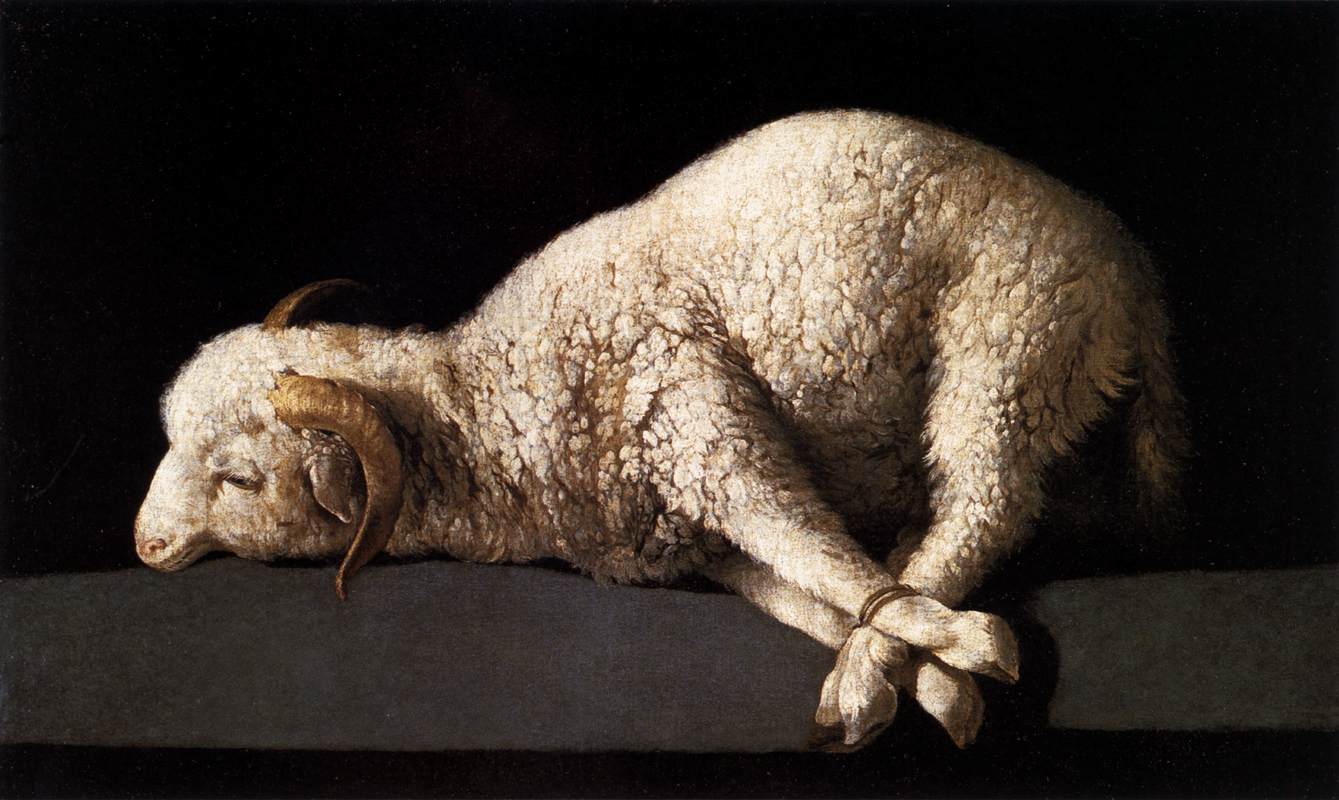
 Francisco de Zurbaran, (Spanish painter, 1598-1664) Agnus Dei (1635-40), bound lamb with horns. Canvas 38 x 62 cm. Museo Nacional del Prado, Madrid.

Agnus Dei, Francisco de Zurban (1598-1664)
Francisco de Zurbaran (1598-1664), "Agnus Dei" (1635-40) ,Canvas 38 x 62 cm. Museo Nacional del Prado, Madrid. Larger image.


Woodcuts

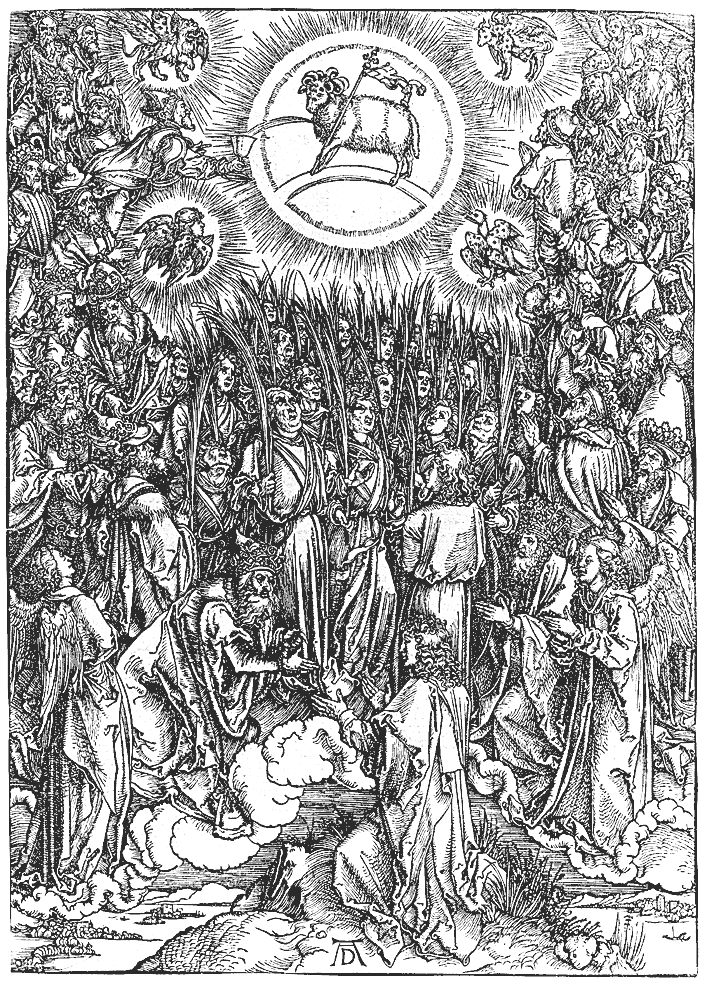
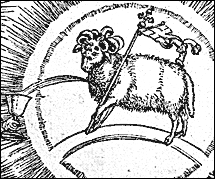
Albrecht Durer, detail of Adoration of the Lamb
Detail  of "Adoration of the Lamb"  (1496-98) woodcut by Albrecht Durer. Larger image.

Albrecht Durer (German painter, 1471-1528)
Adoration of the Lamb (1496-98), woodcut in Apocalypse of St. John series, each 39 x 28cm,  Detail.


  • Sculpture, Carvings of Lamb of God  

Painting of Scene with John the Baptist pointing to Jesus as the Lamb of God

Dieric Bouts d. Ä. (1410 - 1475) (1410 - 1475), "Ecce Agnus Dei", (1462/64)

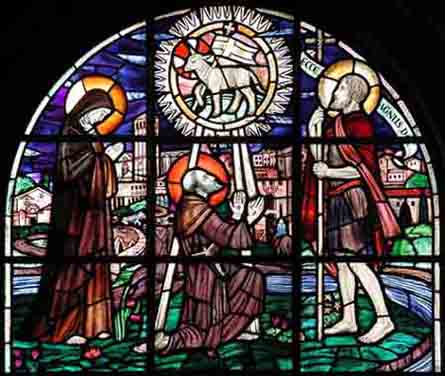
Agnus Dei Stained Glass Windows

Mosaic Tile

  • Floor of Nativity of Mary Blessed Virgin Catholic Chruch, Schulenburg, Texas, Lamb of God. A Painted Church of Texas!

Miscellaneous

Collections

~~~~~~~~~~~~~~~~~~~~~~~~~~~~~~~~~~~~~~~~~~~~~~~~~~~~~~~~~~~~~~~~~~~~~~~~~~
St. Vincent Bascilica Parish, Latrobe, PA. artist: Joseph Reiter

SOURCES:  
Cyril of Alexandria *

Thoughts from the Early Church @Center for Sunday Liturgy

Living Liturgy: Spirituality, Celebration, and Catechesis for Sundays and Solemnities Year A - 2011, p. 45.  Joyce Ann Zimmerman, CPPS; Kathleen Harmon, SND de N; and Christopher W. Conlon, SM 

* Cyril of Alexandria (d.444) succeeded his uncle Theophilus as patriarch in 412. Until 428 the pen of this brilliant theologian was employed in exegesis and polemics against the Arians; after that date it was devoted almost entirely to refuting the Nestorian heresy. The teaching of Nestorius was condemned in 431 by the Council of Ephesus at which Cyril presided, and Mary’s title, Mother of God, was solemnly recognized.


The incarnation is central to Cyril’s theology. Only if Christ is consubstantial with the Father and with us can he save us, for the meeting ground between God and ourselves is the flesh of Christ. Through our kinship with Christ, the Word made flesh, we become children of God, and share in the filial relation of the Son with the Father.

~~~~~~~~~~~~~~~~~~~~~~~~~~~~~~~~~~~~~~~~~~~~~~~~~~~~~~~~~~~~~~~~~~~~~~~~~~